

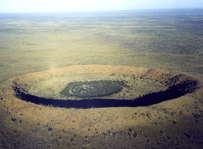
Wolfe Creek Crater, Australia
Gifford Miller, a geologist at the University of Colorado in the United States, has a theory to explain why Australia's so-called "mega-fauna" became extinct around 50,000 years ago. Miller thinks that humans -- specifically the fire they made—was responsible for the loss of these creatures.
The very first people to colonize Australia arrived around the same time that super-sized tortoises and hippo-sized wombat-like marsupials died out. "We suspect," explains Miller, "that systematic burning by the earliest colonizers, differed enough from a natural bush-fire cycle that key ecosystems were pushed past a threshold from which they could not recover." In other words, massive burning caused plants to die, dry rain forests to disappear and the local climate to change. "The big fires set by humans," continues Miller, "disrupted the brush on which the animals depended for food. As a result, all marsupials over 100 kilograms—along with three large reptiles and the ostrich-sized bird called Genyornis newtoni went extinct.”
The theory is engaging—because it explains a number of changes that happened at that time—but it's difficult to prove. Which is why Miller and his team traveled to Wolfe Creek Crater in Western Australia's Great Sandy Desert. Local Aborigines believe that the crater was dug by bandicoots and is the sacred home of the mystical rainbow serpent. Scientists say the crater was formed when a huge meteorite slammed into the earth 300,000 years ago. Whatever the crater's origins, Dr Miller set out to examine the changes in weather patterns - specifically the wet and dry-cycles and associated changes in vegetation—as revealed by the different layers of sediment in the crater. The deep hole acts like a giant dust trap, sequestering pollen and other materials that provide clues to moisture, temperature and wind.
Unfortunately when work at Wolfe Creek was well underway and the results were looking promising, Miller and his team hit a snag. The aboriginal Tjurabalan people of Wolfe Creek asked the scientists to stop their drilling, saying the ground is sacred and should not be disturbed. Respecting the wishes of the tribal elders, Miller's team ended work inside the crater. However, they were allowed to drill a core in a sand dune just outside formation. Preliminary results show that there was a change in vegetation at the time expected, which could be evidence of the fire-induced drying Miller thinks happened 50,000 years ago.
In the meantime, Miller's team has been following up another line of research—that of analyzing fossilized eggs of the big Genyornis bird. Examination of the eggshells of this large, flightless bird in three different sites across Australia indicate that indeed, this giant species died out around 50,000 years ago. The researchers are also studying ancient eggs of emus that lived alongside the Genyornis. It turns out that at the same time the Genyornis died out, the emus changed their diet. The scientists believe this means rainfall changed, altering vegetation. The emu adapted but the Genyornis didn't.
Gifford Miller has a theory for why rainfall might have declined. He believes that the many fires set by the first humans in Australia cleared the dry rainforest, which burns easily, and this in turn reduced recycling of water from the plants back into the atmosphere. "And that caused an increase in aridity across the continent," says Miller, "from which it never recovered."
Related Links
Wolfe Creek Crater, Australia
- Listen to Australia’s Lost Giants (29:23), Dan’s documentary for Radio Netherlands about Miller’s research
- Listen to Aboriginal Climate Change (7:30), Dan’s feature report for National Public Radio about Miller’s research